



Carte blanche to Benjamin R. Taylor — AM STRAM VIDÉOGRAMME
Am stram vidéogramme is a program created by Benjamin R. Taylor as part of Vidéographe's invitation to the artist.
Benjamin R. Taylor is an independent artist with work exhibited in international festivals and cinemas. He is also an independent film curator, programmer and facilitator. He is the founder and facilitator of VISIONS, an independent curatorial series that foregrounds artists working in experimental and documentary cinema. He is a cofounder and caretaker of la lumière collective, a microcinema and artist studio in Montréal, Québec, Canada.
List of works in program
Am stram gram,
Pic et pic et colégram,
Bour et bour et ratatam.
A rhyme without reason, syllables that have bounced through generations. We have inherited the rhythm; the sense having evaporated long ago. What remains is the shape - pure cadence - something that has slipped out of meaning yet continues to roll on our tongues.
They say it may once have been the poetic summoning of a celestial wolf or perhaps it was a counting chant, a Germanic remnant woven into French-language children’s games. Maybe the words were always nonsense. Maybe nonsense is the point: a form become meaning, a fascination with the medium, if you will.
Am stram vidéogramme
When I was asked to curate a programme from Vithèque - Videographe’s immense reservoir of video history dating back to the 1970’s - I was instantly drawn to the “videogrammes” that had retained a certain shape, an energy, a pulsing experimentation. These works called to me across time not because their stories remained urgent or their politics precise (they do and there are many other such works in the collection), but because their curiosity about a medium and a form was at their core. These works have been squeezed through the magnetoscope and have passed over the decades, through shifts in technology and taste, and their form persists. Their rythmns are strengthened by their travels into new and different lands. They are still humming with electricity.
There is a particular period from somewhere in the 1970’s to somewhere in the 1990’s that could be vaguely called “after celluloid” and “before digital” - when video was still a strange creature, thick with electrons and stubborn tendencies, difficult to use subtly. In this period, artists took to hacking, twisting and subverting the new machines of the analogue “revolution” and Vidéographe was a place that welcomed, and shaped, many such artists. People were exploring what video could do that film could not, and, without knowing it, what could never again be done in quite the same way once the digital claimed to have supplanted analogue video along with everything else.
In art, what captures me, what wakes me up, is when we witness, and become entwined with, an encounter between an artist and their medium. In the case of this selection of vidéogrammes, each one reveals a moment when a person touched a machine and the machine touched back. A relationship ensued. An examination. A dialogue. A dance. An interrogation. Throughout this programme, artists encounter video as pigment, electricity, movement, signal or a warping of time. These artists don’t use video to represent the world; they use video as a world. They sculpt in electrons, in waves, in pixels – summoning the almost touchable surface of the analogue image. They reveal the new apparatus not as a neutral tool but as a collaborator, a provocateur, a living agent. Pleasure, reflection and engagement ensue when the artist touches their material and in turn lets the material restructure time and perception. The “video” of these vidéogrammes asserts itself - these works could not exist in any other medium. They belong to their very particular moment - volatile, electric, material - and yet they bounce into our present, imposing their rhythms.
What ties these works together for me is not their subject matter but their impulses. They exist in the interval between curiosity and capacity, between what the machine allows and what the artist desires. They are encounters rather than statements. They are experiments with striking conclusions and wonderful questions. To watch them now is to time-travel - but not nostalgically. More like stepping into an ever-electric present. Like Am Stram Gram, these works are shapes pushed through time. Their original meanings - political contexts, technological excitement, the minutiae of their era - may have changed slightly, but their shapes remain. Their rhythms persist and reach out and catch my eye and ear. I’m not one to bring politics and social readings of such works to the fore, but these are never really far away, floating on each electric surface. Each artist’s engagement with their medium is a very real and direct intervention into the politically charged structures of the image and media-making. Through their forms, the works in this programme ask very important questions about our relationship to machines, our relationship to images, our relationship to others. The playful, the uneasy, the addictive, the dangerous, the ecstatic, the metamorphic. Video as a mirror that distorts; as a memory that repeats; as a pulse that becomes abstraction; as a companion that rearranges the senses and meanings so we might see anew.
WHAT! (FECHNER’S LAW) (1987) - CHRIS MULLINGTON
What! tee vee! test pattern! take a bite!
Roller-zoku! cans of Coke! everything! pop! culture ! pop!
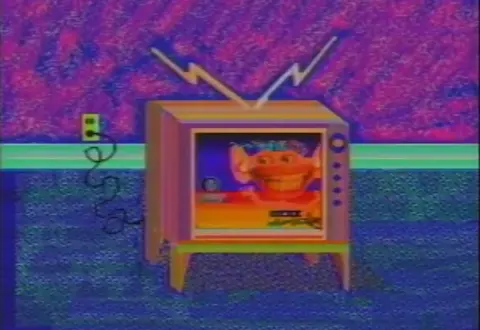
Three minutes of manic collage — soap operas, Japanese rockabilly, an electric chief in headdress, flickering calibration. Attraction, repulsion, family, sex, violence, play. A bite taken out of saturation. This is video at full speed: montage as overload, colour as impact, rhythm as compulsion. A psychedelic celebration of garbage and brilliance, punk and beloved teevee. Knowing it’s impossible, Mullington tries to say everything all at once about the desensitization that comes with the ever-increasing stimulus of the image cascade - and finds joy there. A contemporary nonsense rhyme, zany, anxious, addictive.
PHONOPTIC (1974) — JEAN-PIERRE BOYER
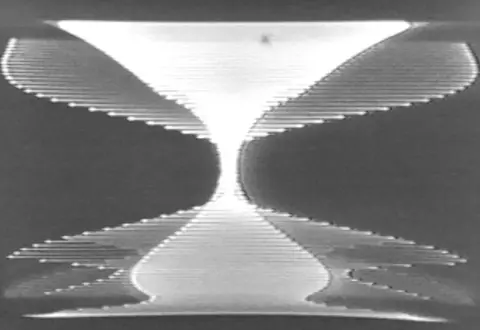
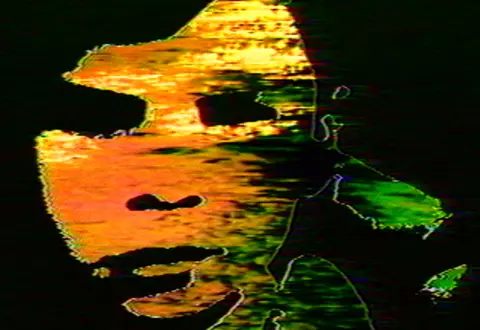
Space dissolves. We are inside the television. Warm synthesis, living waves — electricity that breathes. Video becomes an organism: mutating, microbiological. Forms flicker between the infinitely small and the infinitely vast, as if we were oscillating between microscope and telescope without ever passing through the middle. Boyer pushes the signal to its limits, folding sound into image, image into vibration. Abstraction becomes tactile. A cosmology hums inside the circuitry. Not anti-television but a demystification of it, opening the medium from within - revealing infinity contained, eternal potential, and the electronic image as a space for free, sensorial inquiry.
L’IMAGE DE LA MÉMOIRE (1987) - YVES DOYON
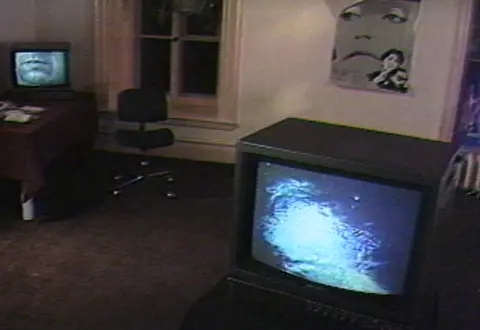
The television is in the room. Memory is already on tape. Images return in waves — just now, just now, just now - or not. A woman reads and rereads fragments of a story, pressed by a man, or by herself. Somewhere, a death interrupts everything. Screens fold into screens. Looks cross from monitor to face and back again, and we watch the watching. Time loops, delays, hesitates. The present passes as it repeats. Memory becomes a chamber shaped by the apparatus - claustrophobic, rhythmic, insistent. Not a story but a circuit. A caress of the image, endlessly deferred.
BETWEEN THE LIGHT AND THE DARK (1987) - SCOTT ROBINSON
Spaces fade in and out of one another, as if two worlds were briefly sharing the same breath. Video mixing becomes dream-tableaux: stones, open hands, seawater, a figure emerging like a ghost. Colours are deep and saturated - painterly, yet unmistakably electronic. Voice and longing instrumentation drifts through the soundtrack, slow as a tide. There is solemnity here, and theatre. The images do not always settle comfortably; they strain, resist, press against one another. But this friction is the work’s pulse - the effort of speaking between states, between what the medium knows and what it is still learning to contain.
SYNTAX ERROR IN 84: PART 1 - MACHINES/MACHINES (1985) - PIERRE ZOVILÉ
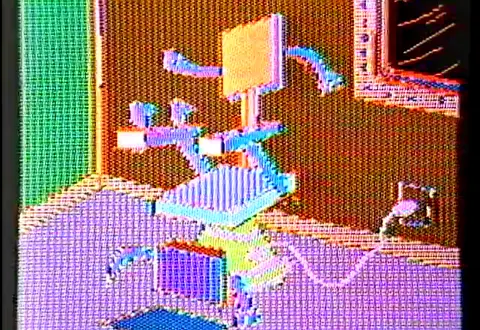
Looking at machines through a machine. A tractor. A television. An electric chair. A camera. A computer. Tools that promise salvation and threaten destruction in the same breath. Born from micro-technology and the excitement of early home electronics, the work hums with curiosity and unease. The humour is dry, the images sharp, almost clinical. Beneath the wit lies a shift: the machine is no longer just a tool or a toy to be joyfully explored. It is becoming an infrastructure of power. The question drifts from what video can do to what technology will become - and what it is already taking shape within and around us.
[o-o]
Sounds pushed through time and images pushed through electricity. Echoes of a celestial wolf. Encounters with machines. Moments when an artist touched video and the door opened. Gestures preserved in magnetic dust.
The vidéogramme is in society / society in the vidéogramme
Our memories are on tape / from the tape we shape our memory
We are inside the circuit / the circuitry is within
Am stram gram,
Pic et pic et colégram,
Bour et bour et ratatam.
—Benjamin R. Taylor, curator


